



 by
by 
The architecture of the global monetary system is facing a breaking point. The policy spearheaded by Donald Trump’s administration, articulated in the so-called Mar-a-Lago Accord, seeks to engineer a deliberate devaluation of the dollar to make exports cheaper and reduce the trade deficit. This break from the long-standing “strong dollar” doctrine has ignited the market dynamic known as the Sell America trade, triggering steep declines in the DXY index and accelerating the greenback’s loss of purchasing power.
Against foreign exchange volatility, persistent inflation, and negative real yields on U.S. debt, major capital allocators are rapidly rotating toward tangible safe-haven assets. Holding cash reserves or conventional financial instruments in dollars today represents a silent risk of wealth erosion.
In this macro environment, investing in the Riviera Maya stands out as one of the most reliable wealth preservation hedges across international markets. Acquiring property and pre-construction developments in destinations like Tulum, Playa del Carmen, or Puerto Morelos allows investors to lock in entry costs, secure strong appreciation driven by urban expansion, and capture consistent cash flow through dollarized vacation rentals backed by steady international tourism.
Table of Contents
The Devaluation Strategy: The Mar-a-Lago Accord and the End of the Strong Dollar
For decades, global markets operated under a foundational assumption: the United States maintained an explicit strong dollar policy that provided stability to international commerce and lowered borrowing costs for Washington’s fiscal deficit. However, the current administration has broken this consensus by prioritizing an aggressively protectionist framework designed to deliberately weaken its own currency, aiming to revitalize domestic manufacturing and extract trade concessions worldwide.

From ‘Reserve Currency’ to Weakened Tender: The Stephen Miran Doctrine
The conceptual blueprint behind this currency shift rests on the framework outlined by Stephen Miran, Chair of the Council of Economic Advisers (CEA). His thesis reframes the dollar’s traditional “exorbitant privilege” as a structural burden: he argues that foreign central banks’ inelastic demand for dollar reserves artificially overvalues the currency, depresses the price of imports, and systematically hollows out the American industrial base by compelling the U.S. to export Treasuries instead of manufactured goods.
The operational layout of this model, known as the Mar-a-Lago Accord, relies on unprecedented coercive tools. Core measures include broad tariff hikes used as geopolitical leverage, conditioning defense and security guarantees on trade partners appreciating their currencies, and floating punitive mechanisms—such as user fees on sovereign reserves or forced conversions of liquid short-term paper into century bonds or perpetual debt.
The “Sell America Trade” and Treasury Bond Volatility
Financial markets have responded not with orderly industrial restructuring, but with a pronounced risk-off wave known across trading desks as the Sell America trade. Institutional investors, sovereign wealth funds, and European asset managers began unwinding U.S. positions or purchasing massive foreign exchange hedges to strip out currency risk, pushing the DXY index down more than 9% annually and extending its decline to multi-year lows.
This dynamic precipitated a severe breakdown in historical correlations: yields on 30-year Treasuries surged past the 4.9% and 5.0% thresholds. Under typical market conditions, those yields would have attracted massive foreign inflows and strengthened the greenback. Instead, the dollar continued to slide, proving that international capital now demands a substantial risk premium over fears of structural inflation and the deliberate debasement of U.S. sovereign obligations.
Imported Inflation and the U.S. ‘K-Shaped’ Economy
Despite official talking points praising a weaker dollar as an export engine, a depreciated currency functions as a sharp double-edged sword domestically. A declining exchange rate paired with sweeping tariffs immediately raises the cost of imported components and consumer staples, generating stagflationary pressures that erode any theoretical manufacturing cost benefits.
This impact unfolds unevenly across a deeply divided K-shaped economy. While the top 20% of earners temporarily sustains discretionary spending on services thanks to prior asset gains, middle- and lower-income households bear the brunt of relentless living-cost increases. The steep drop in real purchasing power weakens the domestic base and accelerates broader macroeconomic fragility.
The Great Capital Rotation: From Paper Collateral to Tangible Assets
The fading dominance of the dollar as the undisputed, risk-free global collateral has triggered a structural shift across institutional and private balance sheets. Confronted by policy unpredictability and negative real returns on sovereign debt, capital allocators are executing a historic rotation away from paper IOUs toward productive tangible assets that intrinsically adjust to monetary shocks.
Why Capital Is Fleeing Liquid Debt for Safe Havens
Liquidity is abandoning paper debt because proposed levies on foreign reserves and political interference in Federal Reserve autonomy function, in essence, as a form of disguised default (soft default). Keeping idle cash in American bank accounts or holding long-duration treasuries no longer preserves wealth; it practically guarantees real capital destruction as inflation outpaces purchasing power.

This search for genuine capital protection has driven record rallies in precious metals like gold and silver, but its primary beneficiary has been prime residential and luxury resort real estate. Unlike fiat paper vulnerable to unilateral regulatory shifts, high-quality real estate in premier international destinations cannot be diluted by executive orders, and its underlying valuation naturally scales alongside global inflationary cycles.
Emerging Market Yields vs. U.S. Purchasing Power Erosion
Over the past decade, Wall Street absorbed nearly 70% of global equity index weight, creating stretched multiples across U.S. assets. As that cycle peaks, sophisticated investors are mirroring strategies deployed during previous multi-year dollar downswings (such as 2002–2008), shifting capital toward emerging regions backed by durable demographic and economic tailwinds.
Markets that offer legal stability, openness to foreign direct investment, and sustained urban expansion represent compelling alternatives to a slowing U.S. landscape. Hubs where capital deployment converts into physical infrastructure and healthy market absorption offer yields well above stagnant traditional financial products, creating an ideal operational setup to safeguard wealth through property.
Why the Riviera Maya Is the Premier Wealth Haven Against a Weakening Dollar
As international capital reorganizes, destinations delivering operational liquidity, strong property rights, and perennial global travel demand are capturing top investor allocations. Southeast Mexico—anchored by the Riviera Maya—has evolved from an internationally celebrated vacation strip into a robust tangible financial hub capable of shielding portfolios from advanced-economy inflation.
Dollarized Vacation Rental Income vs. Competitive Acquisition Costs
A prime structural advantage of investing in Quintana Roo real estate is its favorable operational spread: entry pricing, closing fees, and holding costs remain significantly lower than in equivalent markets across the U.S. or Europe, while cash flow is generated in a high-demand, globally liquid currency.
The premium vacation rental ecosystem and professionally managed condo-hotel developments benchmark their night rates in U.S. dollars, adjusting automatically to international travel trends. This structure allows property owners to generate recurring hard-currency cash flow that counters currency devaluations, delivering a total return on investment (ROI) that substantially outpaces traditional banking instruments.
Sustained Appreciation: Tourism Growth and Regional Infrastructure
Property appreciation throughout the Riviera Maya is underpinned by massive public and private infrastructure spending rather than speculative bubbles. Benchmark real estate valuation indexes show coastal and prime urban corridors across southeast Mexico consistently appreciating well ahead of national inflation figures.
The consolidation of the Maya Train, modernized regional highways, and full operations at Tulum International Airport have transformed connectivity throughout the Yucatán Peninsula. These upgrades unlock previously underserved micro-markets and sustain healthy inventory absorption. This infrastructure backbone drives structural capital gains across land and residential developments, establishing real estate as an enduring hedge for generational wealth.
Geographic Diversification and Insulation from U.S. Sovereign Risk
Concentrating total wealth within institutions governed solely by Washington’s regulatory jurisdiction leaves an investor vulnerable to fiscal deterioration, tax expansion, and capital restrictions. True financial diversification does not require abandoning dollar-denominated trade; it means separating your underlying physical property from a single nation’s sovereign and institutional risk.
Acquiring real estate in the Riviera Maya offers balanced international diversification. You own a tangible asset protected by Mexican property law, located in one of the Western Hemisphere’s most resilient international travel hubs, completely insulated from policy shifts or banking friction within the U.S. financial system.
Keys to Capitalizing on the Currency Shift in Southeast Mexico
Maximizing a currency hedge in the property market comes down to timing your entry and selecting the right project model. Entering during an exchange rate transition requires prioritizing structures that optimize pricing spreads and offer turnkey asset management.
Pre-Construction Opportunities: Buying at a Discount Before Full Absorption
Pre-construction real estate serves as an effective mechanism to leverage capital against depreciating cash. Purchasing residential units or master-planned lots during early rollout stages (Friends & Family or phase-zero pricing) locks in a discounted cost per square meter well below delivery valuation.
As construction progresses and surrounding inventory sells out, the buyer captures the full equity appreciation curve without incurring immediate operational costs. Furthermore, established regional developers frequently offer direct, interest-free payment schedules during construction, enabling cross-border buyers to optimize payment milestones against favorable currency swings.
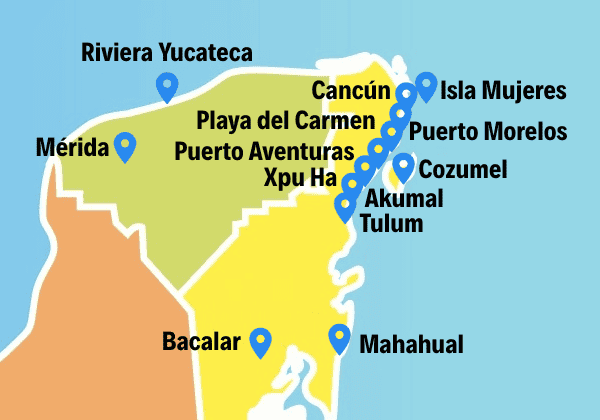
Prime Growth Corridors: Playa del Carmen, Tulum, and Cancun – Puerto Morelos
Each distinct pocket along the Caribbean coast serves a dedicated investment thesis that should match your financial objectives:
- Playa del Carmen: A mature, pedestrian-first market with complete municipal infrastructure. Investor demand focuses on downtown boutique condominiums situated walking distance from the beach, designed to achieve maximum annual occupancy across short-term vacation stays and medium-term digital nomad rentals.
- Tulum: The global standard for wellness hospitality and biophilic, resort-grade architecture. The opening of its international airport solidified its standing for higher-ticket developments, where exclusive eco-amenities and curated lifestyle concepts command exceptional daily average rates (ADR).
- Cancun – Puerto Morelos Corridor: Strategically positioned between Latin America’s busiest air travel hub and the quieter charm of the Caribbean coastline. This submarket is seeing significant demand for master-planned gated communities, residential land parcels, and high-amenity residential complexes.
Legal Structure and Title Security for Domestic and Foreign Buyers
Mexico provides a tested legal framework ensuring full ownership rights for both domestic citizens and international investors. Within the coastal restricted zone, foreign nationals secure full legal ownership through the bank trust (fideicomiso), a statutory mechanism regulated by authorized Mexican financial institutions and the Ministry of Foreign Affairs.
The fideicomiso grants the foreign beneficiary complete legal authority to use, occupy, lease, sell, or bequeath the property with complete constitutional security. Backed by certified public notaries (Notarios Públicos) and professional real estate advisory firms, the acquisition process is transparent, secure, and shielded against arbitrary regulatory changes.
Conclusion
Positioning Ahead of the Market Before Purchasing Power Erodes
Deliberate currency depreciation cycles and global monetary transitions do not reward passive capital. When fiscal and monetary signals point toward the ongoing debasement of a reserve currency, maintaining idle funds in commercial bank accounts or volatile debt instruments amounts to accepting programmed real-terms losses against inflation and rising asset costs.
Protecting capital against this shift requires transitioning vulnerable liquidity into high-yielding tangible assets. Today, the Riviera Maya offers one of the clearest windows of opportunity in global real estate: a market characterized by competitive pre-construction pricing, infrastructure-backed capital appreciation, and resilient foreign exchange cash flow from dollarized vacation rentals.
The optimal window to deploy capital is before continued market absorption and currency adjustments push entry prices higher. At Plalla Real Estate, we continuously track macroeconomic trends and high-growth micro-markets across Southeast Mexico to provide secure, profitable real estate investments backed by rigorous legal certainty.
Protect and Grow Your Capital in Southeast Mexico
Discover curated pre-construction developments, luxury resort-style condominiums, and master-planned residential lots across Playa del Carmen, Tulum, and Puerto Morelos.



Join The Discussion