


 by

Do you think your credit score in the United States or Canada is an insurmountable obstacle to buying your dream home in Mexico? For the vast majority of international buyers who approach Plalla Real Estate, this is the primary question before taking the first step. In North America, the FICO score defines practically everything when applying for a mortgage or renting a home; therefore, it is completely natural to assume that the Mexican financial system operates under the exact same rigorous molds. However, assuming you need a credit history in Mexico—or that your foreign score automatically disqualifies you—is a mistake that can cause you to miss out on exceptional investment opportunities in the country’s southeast.
The reality behind the process is extremely liberating and far removed from traditional myths: the required credit score depends entirely on how you decide to structure your purchase. If you plan to acquire a property with cash or use a payment plan directly with the developer during construction, your financial history will not even be consulted. If you prefer a traditional banking scheme or a specialized cross-border loan, the requirements do exist, but they are perfectly clear and accessible for profiles with healthy finances in the north.
In this detailed analysis, we will break down the five real financing avenues available to foreigners in Mexico throughout this 2026, what financial institutions demand without beating around the bush, how you can optimize your profile before applying, and what the ideal strategy is to secure a transparent, secure, and highly profitable buying process in high-appreciation hubs like the Riviera Maya.
Table of Contents
The 5 Financing Avenues to Buy in Mexico (and Which Ones DO Check Your Credit)
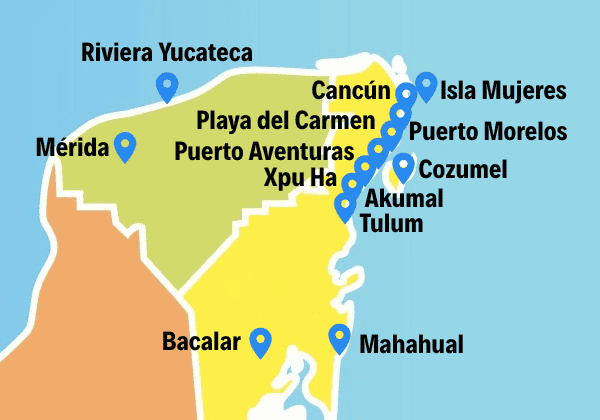
To accurately understand what role your history plays, we must first recognize that the real estate market in high-demand destinations such as Playa del Carmen, Tulum, Cancun, and Puerto Morelos operates with enormous financial versatility. Not all paths go through commercial banking nor do they require an exhaustive credit bureau review.
There are five main routes through which foreign buyers acquire real estate in Mexican territory. Knowing them thoroughly will allow you to rule out unfeasible options and focus your resources and time exactly on the alternative that best suits your current economic reality.

Option 1: Cash Purchase — Zero History Review
Approximately 90 percent of real estate transactions carried out by foreign buyers in Mexico are closed through cash purchases. If you have liquidity through accumulated savings, investment accounts, or proceeds from the sale of another property in your home country, your credit history is completely irrelevant to the public notary and the seller.
This path is much more common than most novice investors suppose. Many buyers in their financial maturity stage liquidate their real estate assets in the north to diversify their capital in the Mexican southeast, capitalizing on sustained appreciation and the attractive yield of vacation rentals. The operational process is direct: you transfer funds via a secure international transaction backed by authorized currency exchange intermediaries, sign the deeds before a public notary, and receive the keys to your new asset without any credit bureau auditing your FICO score.
Option 2: Direct Developer Financing in Presales
If your goal is to acquire a property in the presale stage or new construction—the predominant and most profitable commercial model in Tulum, Playa del Carmen, and Cancun—the real estate developer itself temporarily becomes your financing entity. In this scheme, banking institutions do not intervene, there are no traditional mortgage origination fees, and no credit history inquiry is made.
The mechanism operates through a private transfer contract: you provide an initial payment (down payment) that usually ranges between 30% and 50% of the total value, and you settle the remaining balance through scheduled monthly payments structured as the physical construction of the development progresses. The developer is exclusively interested in your punctuality and compliance with the payments of that specific contract, completely ignoring your financial history abroad.
Option 3: HELOC or Refinancing Your Home in the United States or Canada
This is one of the favorite and most efficient alternatives among North American buyers who want to leverage their current wealth. It consists of using the accumulated equity of your primary residence in the United States or Canada through a Home Equity Line of Credit (HELOC) or a cash-out refinance.
Since you are applying for a loan directly with a financial institution in your home country, North American credit rules and thresholds apply strictly:
- Minimum 620 FICO: Required by most traditional banking institutions for basic approvals, provided you have a very conservative loan-to-value ratio.
- 680 to 720 FICO: The healthy range to access competitive interest rates and favorable terms.
- 740+ FICO: The optimal standard to secure the lowest rates in the North American market and maximize your borrowing capacity.
The structural advantage of this method is that, by obtaining liquid funds in your origin account, you automatically become a cash buyer at the time of formalizing the notary transaction in Mexico.
Option 4: Cross-Border Mortgages
Cross-border mortgages represent the premier specialized solution for those American and Canadian buyers who prefer to directly finance a portion of their property in Mexican territory using the same credit history they have consolidated in the north, as it is the only financial record they have.
In this ecosystem, sophisticated financial institutions operate to evaluate your migratory and asset profile under transparent parameters. Below, we break down current requirements and exact scores demanded by the leading entities in the sector:
MoXi Requirements for US Buyers (Minimum 700 FICO and LTV Rules)
MoXi (formerly Global Mortgage) stands as the cross-border lender with the highest placement volume for US citizens acquiring real estate in Mexico. Its risk policies are strict:
- Minimum 700 FICO: This is the essential threshold mandatory to qualify in the initial credit evaluation.
- 720+ FICO: Grants you access to a standard loan-to-value (LTV) ratio of 65 percent, which implies covering a down payment of 35 percent.
- 700 to 719 FICO: This range reduces the permitted LTV to 50 percent, forcing you to provide a 50 percent down payment on the commercial value of the property.
- Below 700 FICO: Not eligible. The institution formally recommends cleaning up and optimizing the score in the bureaus before submitting the application folder.
For its assessment, MoXi checks the three credit bureaus in the United States (Equifax, Experian, and TransUnion) and takes the middle score as an analytical reference, exactly replicating US mortgage banking protocols.
International Alternatives: Yave, MortgageHub, and Veltra Capital
The financial brokerage market offers other options with specific approaches that you should consider:
- Yave: A digital platform rooted in Mexico that offers cross-border products aimed at buyers from the US, Canada, UK, France, and Germany. It advertises schemes with down payments starting at 15 percent under solid profiles, requiring a good history in the country of origin (operationally interpreted as 680+ FICO). Its loans are usually denominated in Mexican pesos (MXN), which introduces foreign exchange risk exposure.
- MortgageHub: A brokerage network with access to Mexican lenders that establishes a minimum of 689 FICO for wage earners and independents, and 725+ FICO for preferential rates. It allows up to 80 percent LTV (20 percent down payment) and operates independently of your migratory status, even admitting tourist visas.
- Veltra Capital: A specialized option with financing denominated in US dollars (USD), offering up to 70 percent LTV on new properties (30 percent down payment) and 60 percent on second-hand real estate (40 percent down payment).
Option 5: Traditional Mexican Banks — Are They Viable for Non-Residents?
First-tier banking institutions in the Mexican system such as BBVA, HSBC, Santander, and Banorte commercialize a wide range of residential mortgage loans; however, in practice they prove highly impractical for the non-resident foreign buyer.
To qualify in these institutions, guidelines require having permanent residency in Mexico, proving income fiscally within national territory, and undergoing an evaluation in the local Credit Bureau (Buró de Crédito). If you live permanently abroad and your income comes from the north, this route lacks operational viability and should be ruled out of your initial plan.
How Can You Improve Your Credit Profile Before Applying for a Cross-Border Loan?
If your strategy points toward using a cross-border loan in the coming months and you wish to guarantee approval under the best market rates, we suggest implementing the following corrective actions:
- Optimize your card utilization rate: Keep your outstanding balances below 30 percent of the authorized credit limit. Even if you pay in full month by month, the cutoff reported by the bureaus can show high utilization if your cards operate at their limit. Pay off balances at least 60 days before applying for the mortgage.
- Avoid unnecessary hard inquiries: Applying for auto financing, department store cards, or personal loans in the previous months generates “hard inquiries” that temporarily depress your FICO score.
- Preserve the age of your accounts: The average life of your credit lines brings statistical stability to your profile. Avoid canceling old cards, as this shortens your history and reduces your overall score.
- Substantiate the source of funds (Seasoning): International lenders require that the capital destined for the down payment remain “seasoned” (deposited and without strange movements) in your bank accounts for a minimum period of 60 days. Avoid massive last-minute transfers that trigger compliance alerts.
Quick Guide: What Is the Ideal Path According to Your Financial Situation?
To speed up your decision-making and avoid unnecessary wear and tear on procedures incompatible with your profile, rely on this strategic matrix:
- Profile with excellent credit (740+) and real estate wealth in the north: Use a Home Equity Line of Credit (HELOC) or a refinance. You will get the most competitive rates and position yourself as a cash buyer in Mexico.
- Profile with solid credit (700–739) without immobilized liquidity in North America: Opt for a cross-border loan with specialized lenders like MoXi, projecting a 35 percent down payment.
- Profile with a history lower than 700 but with available liquid capital: Execute a direct cash purchase from your investment funds or savings, or take advantage of direct developer financing schemes in presales.
- Profile with a history lower than 700 and developing liquidity: Focus exclusively on presale developments with deferred payment plans during construction, buying time to clean up your score before evaluating any future refinancing.
Conclusion: Your History Should Not Stop Your Investment in the Riviera Maya
The widespread myth that a perfect credit history is needed in Mexico to acquire a property is completely demystified when analyzing the versatility of mechanisms that the current market makes available to foreign investors. Far from being an insurmountable bureaucratic barrier, the acquisition system in destinations like the Riviera Maya flexibly adapts to different liquidity profiles, saving capacity, and asset strategies.
Whether you choose the immediacy of a cash transaction, the convenience of a structured payment plan with a presale developer, or the legal formality of a cross-border mortgage backed by your FICO history, the true success of an international real estate investment lies in rigorously aligning your financial reality with the right purchase vehicle from day one. Understanding the rules of the game gives you absolute control, eliminates operational surprises, and shields your capital against hasty decisions.
At Plalla Real Estate, we have the firm conviction that a successful asset decision begins long before signing a deed before a notary: it starts by deeply understanding the legal and financial environment, evaluating each alternative with technical rigor, and charting a clear path toward your long-term goals. If you have questions about which option best aligns with your current situation or want to know the most solid investment opportunities in Playa del Carmen, Tulum, Cancun, and Puerto Morelos, our team of specialists is prepared to accompany you at every stage of your asset process.


Join The Discussion