


 by
by 
Talking about safety in Mexico usually generates mixed reactions. For some, the perception is dominated by alarmist headlines; for others, by deeply positive personal experiences.
The reality —as is almost always the case— lies somewhere in the middle. Mexico is a huge, diverse, and complex country, and reducing its safety to a single narrative is as inaccurate as it is unfair.
The infographic circulating widely on social media summarizes this idea provocatively: more than the country itself, traveler behavior is the key factor that determines the level of risk. Let’s analyze it with logic, not fear.
Table of Contents
The true deciding factor: involvement (or not) in illegal activities
The first point raised by the infographic is as direct as it is uncomfortable: much of the violence in Mexico is related to conflicts between criminal groups.
For the average traveler, the relevant question is not “is there crime in Mexico?”, but:
am I participating in illegal or high-risk activities?
The answer for 99% of tourists is no. Those who do not get involved in illegal economies, criminal disputes, or high-risk environments drastically reduce their exposure to violence, in the same way they would in any other country.
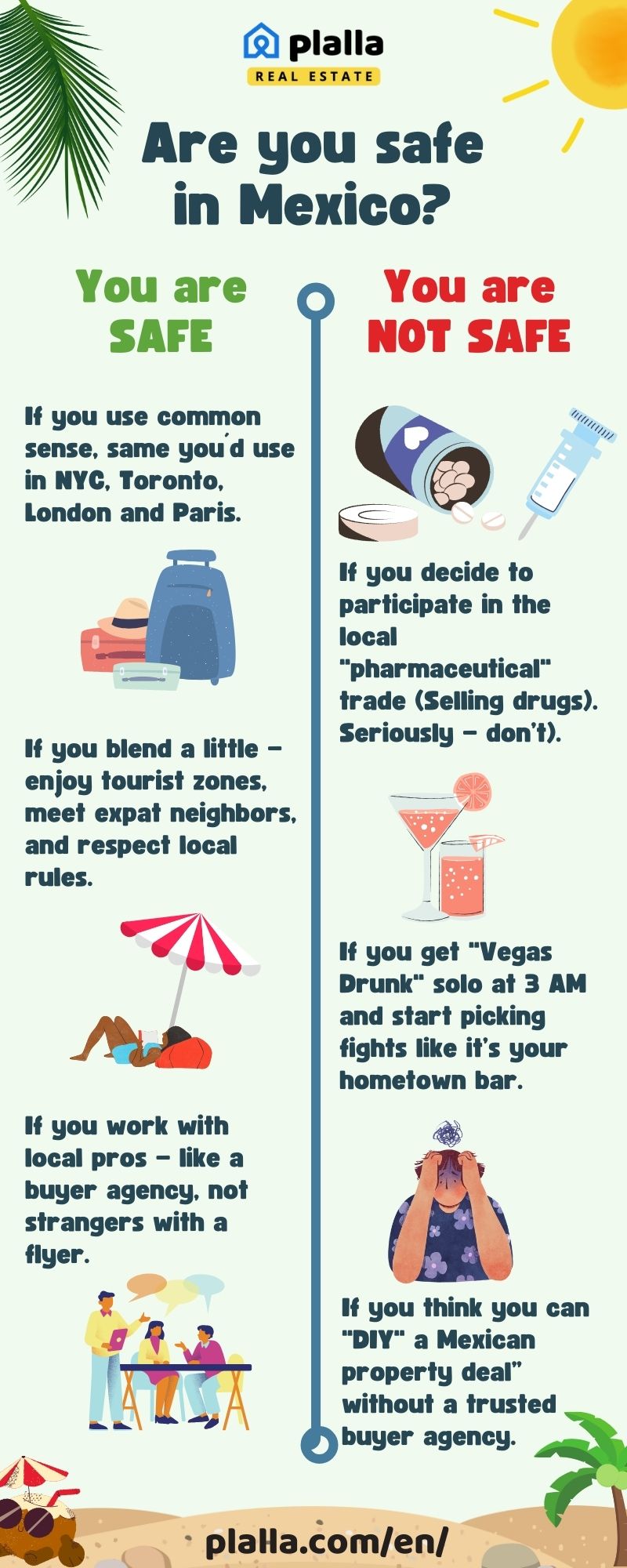
Responsible tourism vs. reckless tourism
Another key point of the graphic is to abandon the idea that risk magically disappears or appears when “leaving the resort.” The reality is more nuanced.
Going out to explore a city, visiting local restaurants, beaches, cenotes, or tourist areas is not inherently dangerous. The risk increases when certain universal factors are combined:
- Excessive alcohol consumption
- Loss of situational awareness
- Unplanned travel/movements
- Impulsive decisions in the early hours of the morning
This pattern is not exclusive to Mexico. It happens in Paris, Barcelona, Miami, or New York. The difference is that, in Mexico, these behaviors are often amplified in the media narrative.
Tourism in the Riviera Maya and the Mexican Caribbean: the real data from 2025
When talking about safety in Mexico, hard data is often left out of the conversation.
However, tourism behavior is one of the clearest indicators of confidence, mobility,
and international perception.
Although there is no single definitive figure for all of 2025, official reports and projections show
a compelling scenario: the Riviera Maya and the Mexican Caribbean exceeded 5 million tourists per year,
with sustained growth throughout the period.
Key tourism figures in 2025
- Riviera Maya: recorded an approximate growth of 5.6% in visitors,
exceeding 339,000 monthly tourists. - Mexican Caribbean (includes Cancun and Riviera Maya): more than
5 million annual tourists, with significant peaks towards the end of 2025. - Quintana Roo (entire state): received more than
18.5 million national and international entries,
exceeding 20 million total visitors during the year.
The key role of the Cancun International Airport
A particularly relevant fact is the performance of the Cancun International Airport,
which consolidated its position in 2025 as the airport with the highest volume of international passengers in Mexico.
During the first half of 2025 alone, international arrivals to Quintana Roo exceeded
900,000 passengers per month, a figure incompatible with the narrative of an unsafe or declining destination.
Projection for 2026: growth and dynamism
Projections for 2026 point toward high tourism dynamism and economic growth
throughout the Mexican Caribbean region, driven by investment, air connectivity, and sustained international demand.
In simple terms: millions of people from all over the world continue to choose to travel,
invest, and live in Quintana Roo. The numbers do not respond to fear; they respond to reality.
The uncomfortable comparison: Mexico and major U.S. cities
The infographic concludes with a provocative statement: for the average tourist acting with common sense, many areas of Mexico are just as safe —or even safer— than major cities in the United States.
Statistically, cities like Chicago, Baltimore, or St. Louis present violent crime rates comparable to or higher than many Mexican tourist destinations. However, few people question if “it is safe to travel to the United States” as a generalization.
The difference lies in the focus: in Mexico, people often speak of the country as a whole; in other places, they speak of neighborhoods, contexts, and behaviors.
Practical recommendations for traveling to Mexico with confidence
Beyond the theory, these basic principles make a difference:
- Use authorized or recommended transportation
- Respect local laws and regulations
- Get informed about the specific area you are visiting (Mexico is not homogeneous)
- Avoid excesses that reduce your perception of your surroundings
- Trust in common sense, not in fear
These tips are not exclusive to Mexico; they are the same rules you would apply in any international destination.
Conclusion: common sense remains the best protection
So, is it safe to travel to Mexico today?
For the vast majority of travelers, yes.
Violence exists and should not be denied, but neither should it be taken out of context. The infographic summarizes it well: the greatest determinant of safety is not the country, but the decisions the traveler makes.
Mexico remains one of the most visited tourist destinations in the world for a reason: its people, its culture, its gastronomy, and its diversity. Traveling informed, aware, and without unnecessary fear allows you to enjoy it just as millions of people do every year.
At Plalla, we believe that clear and contextualized information is the best tool for making smart decisions —whether it’s for traveling, investing, or living in Mexico.


Join The Discussion