


 by

In recent days, the conversation surrounding property tax (predial) has sparked doubts and concern among property owners, buyers, and investors nationwide. This unease is completely understandable: whenever the update of property values is discussed, the immediate reaction is to assume that a blow to the pocketbook is coming in the form of a tax hike. However, there is a fundamental technical and legal difference between increasing a tax rate and updating the cadastral value used as the basis to calculate it.
In October 2026, the Senate of the Republic approved the issuance of the General Law for Cadastral and Registry Strengthening and Harmonization, a decree aimed at modernizing, standardizing, and improving the coordination of information between municipal cadastres and public property registries nationwide. Following its legislative approval, the initiative was forwarded to the Federal Executive Branch for official publication. For this reason, before attributing immediate or widespread fiscal effects to it, it is essential to rigorously analyze what this regulation seeks, what the legal framework actually states, and how it impacts regions with high real estate dynamism, such as the Riviera Maya, in a differentiated manner.
Throughout this analysis, we will break down the key concepts, separate myths from fiscal realities, and guide you step-by-step on what you should review to protect your assets and maintain the profitability of your real estate investments in Mexico.
Table of Contents
What Is Cadastral Updating and Why Is It at the Center of the Debate?
To understand the magnitude of the current discussion, it is first necessary to define what the cadastre is. The cadastre is the administrative registry containing the physical, cartographic, and economic inventory of real estate located within a specific territory. Among its primary data are the exact location, land surface, square meters of construction, physical characteristics, assigned use, and cadastral value.
Conflict arises when this administrative information becomes outdated over time and ceases to reflect the physical and economic reality of a property. For example, a property may have been registered a decade ago, during a period when the area had different infrastructure, lower urban density, or vastly different demand than today. Similarly, it is common for owners to carry out expansions, remodeling, or land-use changes whose modifications were never formally reported to local authorities, creating discrepancies in the records.

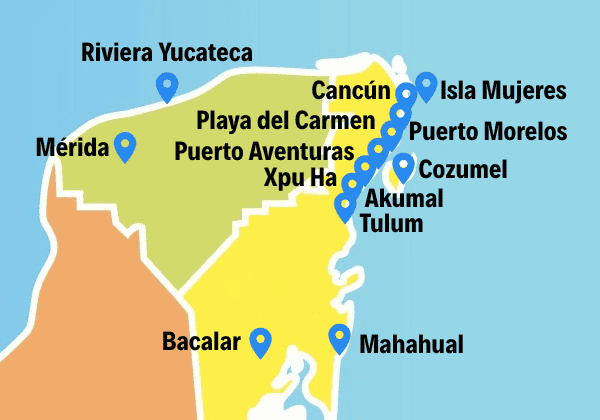
In a real estate market as dynamic and fast-growing as the Riviera Maya—spanning development hubs such as Playa del Carmen, Tulum, Cancún, and Puerto Morelos—keeping cadastral information up to date is a constant challenge. The new federal legislation proposes coordination mechanisms, process harmonization, and the use of advanced technological tools to identify properties more uniformly across the country.
Nevertheless, it is vital to emphasize a key point: cadastral modernization does not, in itself, equate to a generalized increase in the property tax rate throughout Mexico. The authority to set the rates and tariffs of this tax continues to rest with municipalities and local congresses in accordance with their respective revenue laws. The practical effects of an update will depend exclusively on the particular situation of each property, the procedures implemented by each city council, and applicable legal provisions.
The Gap Between Urban Reality and Outdated Records: The Case of the Riviera Maya
Disorderly or accelerated urban growth often exposes the limitations of traditional cadastral systems. In southeastern Mexico, the expansion of new residential areas, tourism developments, and resort-style amenity complexes has radically transformed the economic value of land in just a few years.
When cadastral records do not communicate efficiently with public property registries, information gaps are generated that complicate territorial administration. The harmonization proposed by the new law specifically seeks to close these institutional gaps. For owners and investors, this means local administrations will have better tools to audit the territory, making it essential that each property’s data is in order and legally backed.
Market Value, Cadastral Value, and Property Tax: Differences You Should Know
One of the biggest mistakes in public debate is the confusion of financial and fiscal concepts that are entirely independent of one another. To understand the true scope of any adjustment, it is necessary to clearly separate three fundamental terms:
1. Market Value: This is the estimated price at which a property could freely trade in the real estate market under normal conditions of supply and demand. This value responds directly to external factors such as strategic location, proximity to the beach, exclusivity of amenities, state of conservation, quality of finishes, and the economic timing of the sector.
2. Cadastral Value: This is the official value assigned to a property by the administrative authority for tax and registry purposes, calculated in accordance with land and construction unit value tables approved by municipal councils. As a general rule, the cadastral value is set below the actual market value of the property.
3. Property Tax (Predial): This is the mandatory annual contribution linked to real estate ownership. Its final calculation depends not only on the cadastral value, but on a complex mathematical formula including the tax base, progressive or fixed rates established by each municipality, as well as subsidies, annual increase limits, prompt-payment discounts, or special benefits provided under local law.
Therefore, if a property experiences an increase in market value due to regional appreciation, or if its cadastral value is adjusted to reflect its actual characteristics, it does not automatically mean that the property tax bill will skyrocket in the exact same proportion.

How an Update Influences the Property Tax Amount (Practical Example)
To mathematically visualize how this process operates and avoid unfounded speculation, let us analyze a hypothetical yet representative scenario within the real estate market.
Imagine an apartment whose historically registered cadastral base is 800,000 pesos ($800,000 MXN). Following a physical review process, cartographic update, and the application of corresponding unit value tables, the official cadastral value is adjusted to 1,200,000 pesos ($1,200,000 MXN).
In this specific example, the cadastral base experiences a 50% increase. However, this does not linearly translate into a 50% increase in the annual property tax payment. The final tax settlement will depend on the applicable rate established in the Revenue Law of the municipality in question, which typically includes maximum annual increase caps to protect taxpayers from sudden jumps in collections, alongside tiered tariff structures.
Likewise, it is essential to distinguish between a justified technical update and an administrative registry error. If the built surface area, property regime, or physical characteristics of the property are incorrectly recorded in the municipal treasury system, the owner has the right to be informed about available legal mechanisms to request formal clarification, review, or rectification.
The Real Benefits of Better Cadastral Management for Owners and Investors
Although media attention focuses almost exclusively on fears of a higher tax burden, a comprehensive perspective of the new legislation reveals significant structural benefits in terms of legal certainty, transparency, and urban management.
1. Greater Clarity and Detection of Information Discrepancies
When cadastral records and public property registry folios converge consistently, administrative error margins are significantly reduced. This allows for the early detection of discrepancies in land surfaces, boundaries, or physical characteristics that in the past were typically discovered only at critical moments, such as during a sale or a patrimonial regularization process.
2. Enhanced Asset Certainty for Due Diligence
For buyers and investors allocating capital to the Mexican real estate sector, having more organized and standardized databases provides a superior level of transparency during the document research process (due diligence). It should be noted that cadastral harmonization does not replace notary consultations or historical registry analysis, but it constitutes a highly valuable complementary tool to verify the legal consistency of an asset.
3. Urban Planning and Infrastructure Development
At the macroeconomic and municipal levels, precise territorial information is indispensable for sustainable urban planning. City governments require reliable data on population density, land use, and infrastructure growth to design efficient public policies, provide quality public services to expanding areas, and better justify public investment for the benefit of residents and tourism developments.
4. A More Orderly Environment for Real Estate Risk Analysis
For institutional or private investors, administrative certainty is an integral part of risk assessment. Accurately understanding the legal, fiscal, and registry status of a real estate development enables much more precise financial projections, eliminating operational surprises and strengthening confidence in the markets where capital is deployed.
What This Legislation Means for Investors in the Riviera Maya
In the state of Quintana Roo, as in the rest of the federal entities, it is imperative to separate the general framework of federal cadastral harmonization from strictly local tax and fiscal provisions. Key municipalities such as Solidaridad (Playa del Carmen), Tulum, Benito Juárez (Cancún), and Puerto Morelos operate under their own revenue laws, tax regulations, and unit value tables approved by their respective city councils.
Take the case of Playa del Carmen: each fiscal year, municipal authorities independently publish the land and construction unit value tables that will govern their territorial jurisdiction. This demonstrates why it is a methodological error to interpret a national legislative discussion as an automatic, uniform, or identical change for every municipality in the country.
For domestic and international investors acquiring properties in the Riviera Maya with the goal of generating long-term capital appreciation or commercializing them under vacation rental schemes, property tax represents an item within recurrent operational maintenance and holding costs. Professional financial management requires integrating these types of fixed obligations into the net profitability analysis, jointly accounting for management costs, amenity maintenance, insurance, capital reserves, and low-occupancy periods.
A solid real estate investment strategy is not limited to evaluating the entry price or expected rental return; it thoroughly understands every fiscal and operational burden directly affecting asset performance throughout its lifecycle.
Practical Guide: What Owners and Investors Should Review Ahead of a Potential Adjustment
Given the uncertainty generated by the new legislation and debates regarding the future of property contributions, the best strategy is not to speculate or fall into alarmism, but to adopt a proactive stance based on document review. Owners and investors can follow these concrete steps:
1. Audit Current Cadastral Information: Request and thoroughly review the property tax bill (boleta predial) and cadastral certificate to verify that recorded data—land surface, square meters of construction, location, and use type—exactly matches the physical reality of the property.
2. Consult Local Fiscal Provisions: Review the Revenue Law and unit value tables of the municipality where the property is located for the current fiscal year, identifying applicable rates and potential current benefits or subsidies.
3. Analyze Tax Calculations: If a drastic change or substantial discrepancy is observed in the property tax amount, request a detailed explanation of the tax base and applied formula from the corresponding municipal treasury.
4. Manage Formal Corrections: If errors are detected in physical characteristics or registry data, promptly initiate formal clarification, rectification, or updating procedures before competent authorities.
5. Incorporate Costs into Financial Projections: Update profitability financial models, ensuring property taxes and other holding expenses are properly budgeted within the annual operating costs of the property.
6. Monitor the Legislative Process and Entry into Force: Clearly distinguish between an initiative approved by Congress, its official publication in the Official Gazette of the Federation (Diario Oficial de la Federación), and the actual deadlines established for operational implementation across states and municipalities.
Technical information and administrative procedures can vary significantly from one municipality to another. For any complex fiscal or legal doubt, it is best to rely on the guidance of real estate and notary specialists.
Conclusion: Investing with Strategy Means Understanding Every Component of Your Assets
The public debate surrounding property tax and cadastral modernization should not be reduced to unfounded fears of a generalized contribution hike. Beyond short-term discussions, this process brings to the table an indispensable conversation about how real estate assets are managed, registered, and protected in Mexico.
A well-implemented cadastral update, grounded in transparent technical criteria and accompanied by clear correction mechanisms, strengthens owners’ legal security, improves urban planning, and fosters a much more orderly and predictable investment environment. At the same time, it places responsibility on investors to stay informed, review their files, and rigorously evaluate every component of their assets.
At Plalla Real Estate, we are convinced that a successful asset decision begins long before signing a deed: it starts by deeply understanding the legal environment, analyzing local market behavior, and evaluating each opportunity with a long-term perspective, technical rigor, and strategic vision.



Join The Discussion